06 May, 2026
The Young Writer Delegates Reflect on Cúirt 2026
Every April for the past forty-one years, lovers of literature have travelled from across Ireland, and the wider world to Galway, for the Cúirt International Festival of Literature. In 2026, the festival ran from 21-26 April, and alongside a packed programme of literary events, attendees were blessed with a rare sight in the West of Ireland – the sun.
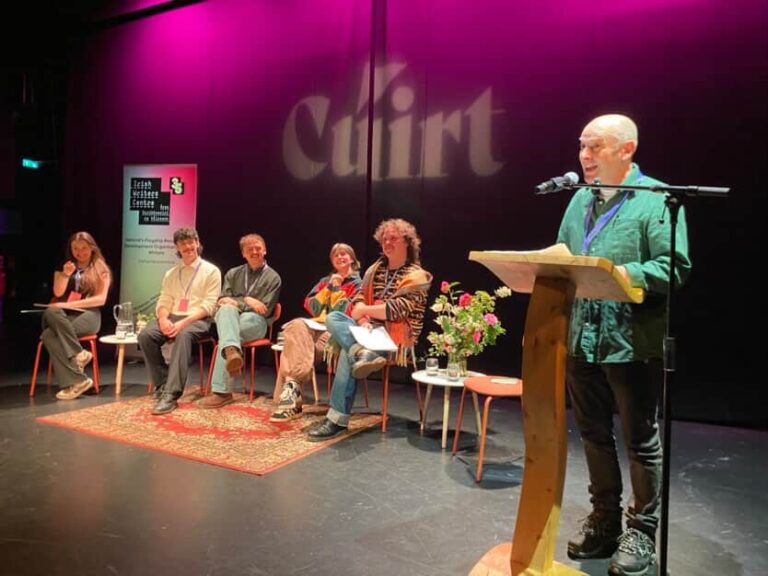
Among those who flocked to Galway were our Irish Writers Centre/Cúirt Young Writer Delegates. The five writers chosen this year were: Liam Carton, Luke Condon, Eddie Critchley, Shauna Murphy, and Sadhbh Valentine Carton. As well as attending the wide variety of panel discussions, performances, and open mic nights around the city, the Delegates also performed at their own showcase to a packed audience in the O’Donoghue Centre for Theatre, Drama, and Performance. Their local writer-mentor Alan McMonagle was in attendance, and acted as MC on the day.
Each year, the delegates attend events of their choice and write a review of their experience; here are the reviews our delegates wrote up for Cúirt 2026!
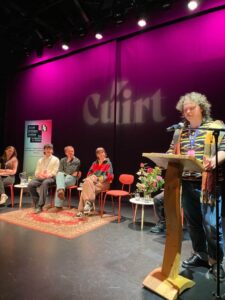
Young Writer Delegate Liam Carton performing at the Showcase.
Liam Carton
As a Galway native, being invited to be a part of the Cúirt festival as a Young Writer Delegate was rather like stepping into a parallel universe, or perhaps a fairy otherworld, and finding my usual haunts and locality transformed into outposts and bastions of literary achievement. In my week-long otherworld I saw faces both familiar and new. There were faces I knew from the creative side of Galway, particularly those from the Oil Slick poetry collective, now in new context and on more impressive stages. Of the new faces I met, there are surely too many to count, but by far the folk I spent the most time with were my fellow Young Writer Delegates and our fantastic mentor, Alan McMonagle. I was thrilled to be among like-minded and creatively ambitious folk and look forward to keeping in touch with everyone in the future.
Of course, I have more than memories to carry with me from Cúirt. My bookshelf is close to overflowing with additions of literary journals, poetry collections and novels.
Regarding journals, The Stinging Fly’s launch of their climate issue was an insightful event to attend and opened a range of discussion about how one may write on the ongoing climate crisis and what other avenues there might be to avoiding catastrophe. The conversation saw heavy involvement from the audience and was, I found, an encouraging antidote to the pessimistic apathy that is so commonly associated with the topic. The atmosphere in the room was seething and the speakers gave no indication of softening their words nor of subscribing to the illusion that the crisis may be solved by literary means alone. I found Ríonach Ní Néill to be particularly incendiary but the entire panel were a font of quotes to hastily jot in my notebook not least of which were affirmations of rage towards prior generations and the powerful (though perhaps paraphrased) doctrine:
“At this age, if I get government funding I think I’m doing something wrong.”
Moving from the immolation of the globe but keeping with the theme of fire, an absolute firecracker of an event (pun both intended and apologised for) was Brendan Mac Evilly’s ‘A Personal History of Pyromania.’ Part book launch, part one man play, part photography showcase, and part ceramics display, Brendan blurred the lines reading, performance, and pyrotechnics as he mused on the blurred lines of memory and fiction. The telling, retelling, misremembering and investigating of the act of burning a uniform grew into a musing on pyromania as a whole and on the relationship between author and character, taking the events of one’s own fiction as an inspiration to live more authentically and, in Brendan’s case, to create a series of truly haunting images of fires burning in the hearths of abandoned homes.
Incidentally, the event was a great showcase for the Mick Lally’s temperature control as I found myself fascinated by how the smoke from the pyrotechnics settled flatly between the strata of the warm and cool air in the theatre.
Maidir le cúrsaí gaeilge, ní beag an méid imeachtaí a bhí ar fáil. Ba é an Deardaoin an lá a dfhreastal mé ar an méid imeachtaí is mó, agus mé idir an Taidhbhearc agus Charlie Byrne’s beagnach an lá ar fád. Bhí mé gafa ag na seisiúin filíochta i dCharlie Byrnes, go háirithe na dánta a bhí scríofa go dátheangach nó fiú go trítheangach ag Ola Majekodumni. Bhain mé an-taitneamh as an meascán mearaí tuisceana focail na ndánta agus ag baint úsáid as na focail sna teangacha a thuig mé chun an teanga nár thuig mé a oibriú amach.
There were many other events that remain as present in my mind as their respective books on my shelf, not least of which would be Adania Shibli’s insightful linguistic analysis on everything from Arabic poetry and synonyms to the distinction of connotations between ‘genocide’ and ‘nakba’ as terms. Claire-Louise Bennett was another speaker whose presence was absolutely captivating and whose books (I must slightly shamefully admit) have been ascended to the top of my ‘to read’ list.
I would be remiss, also, not to mention the social aspect of the festival, particularly between us delegates. It was a joy to have my time behind the reins of the instagram, to welcome my fellow delegates to Galway, and even to have time for a quick dip at Blackrock.
I will conclude with my one lingering criticism of Cúirt, which is that all good things must come to an end. However, with the people I have had the joy of meeting and the literature I have hoarded to sustain me, I am confident I can happily remain in this otherworld year-round.
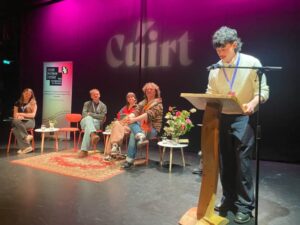
Young Writer Delegate Luke Condon performing at the showcase.
Luke Condon – ‘Close Encounters of the Cúirt Kind’
Social anxiety is a form of egotism; so is writing. I brought both of these maladies with me to Cúirt International Festival of Literature 2026. When reflecting on the week I find it hard to pick out a single event to focus on. I was moved to tears multiple times and also felt a weird sense of literary rapture on more than one occasion. Instead, as it is very easy for me to obsess over my self-perceived blunders in social interactions, I have chosen to chronicle the encounters I had with a number of excellent writers at Cúirt. I’m partially hoping to convince myself that any awkward moment I experienced (and believe me there were more than the five I’m about to list) was only such in my mind and not in reality. Mainly I want to get across the point that the writers listed here are not only massively skilled at their craft, but also massively skilled at being fine folk to have a little yap with.
*
Brendan MacEvilly – A Personal History of Pyromania
Asked him for a photograph to post on the Younger Writer Delegates Instagram account, then proceeded to make a joke about setting his novel on fire. Generally people do not like when you threaten to set their novel on fire, though MacEvilly showed no sign of being offended. In fairness this was after he had spent an hour throwing tiny explosives at the floor of the Mick Lally Theatre and projecting images of things he’d set aflame onto the wall, interspersed with voiceover readings from the book (fittingly named Deep Burn). I hadn’t known what to expect going into this event but I came out so convinced of fire’s power as both a tool for memory-retrieval and an extraordinarily funny punchline that I immediately bought a copy of Deep Burn to see more of MacEvilly employing it in prose.
I’d intended on just getting a photo of MacEvilly holding the book for the Instagram page but he insisted I get in the frame too. This was, in my opinion, a lovely gesture. As small as it was it assuaged some of my impostor syndrome—here I was, at Cúirt, getting a photo with a novelist! I must really have been moved because in the picture it looks like I’m about to cry while MacEvilly is all smiles. A trick of the light, I promise.
Marie Heaney – The Poems of Seamus Heaney
I sat next to Marie Heaney at the Town Hall Theatre in the audience of an event celebrating Seamus Heaney’s life and work. To my shame I did not recognise her. At the end of the night she asked me if I was involved with Cúirt in some way—owing to the pretty pink lanyards the Cúirt team equipped us with—and me all proud I went on a big spiel about my esteemed role as a Young Writer Delegate at Cúirt, which she listened to with patience before very politely informing me she was Seamus Heaney’s wife. I felt very embarrassed but we got a good laugh out of it. Later I would discover Marie has published and edited several collections of poems and Irish legends herself.
Marie spoke to me and the other Young Writer Delegates for a bit, saying she thought it was lovely young people were interested in Seamus’ work. His sonnet ‘The Skylight’ was read out during the event, and Marie pointed out with a chuckle that she was ‘the one for the skylights’ mentioned within. After talking to this wonderful woman and having listened to so many recitations of her late husband’s beautiful words, my earlier embarrassment quickly faded; embarrassment is a self-absorbed thing and there was no call for self-absorption here. As Seamus puts it in that poem, I felt
‘like an inhabitant
Of that house where the man sick of the palsy
Was lowered through the roof, had his sins forgiven,
Was healed, took up his bed and walked away.’
Adania Shibli – Adania Shibli: Minor Detail
When asked to translate the term Nakba for the English-speaking audience during her conversation with Anne Enright at the Town Hall Theatre, Adania Shibli did not immediately attempt to find an equivalent word, because of course no such thing can exist between languages. She simply, but at the same time not simply at all, said it ‘carries a feeling of loss’. The discussion encapsulated so much about the suffering of Palestinians, the brutality they were and remain subjected to, but this in particular stuck with me. It will for the rest of my life.
After the event ended I waited for the crowd to die down and hopefully get a signed copy or two of Shibli’s novel Minor Detail. I met Alan, our writer mentor, outside and he suggested that I get the books signed in Arabic, which felt very fitting to me. Shibli was, I think, delighted to oblige. The awkward moment here came later, when I went off into town to present one as a gift to my girlfriend and realised that as a result of my not speaking Arabic I had no way of distinguishing which one was addressed to her. Much poring over online Arabic alphabet charts ensued.
Anne Enright – Adania Shibli: Minor Detail
I found Anne Enright looking very cool, sat next to Shibli with a glass of white wine at her side (I envied this almost as much as I do her incredible prose). Nervous as I was—Enright was a writer I had read and loved even before coming to the festival—I planned to break the ice with the confession that I had stopped reading her Booker-winning novel The Gathering halfway through as a result of losing access to the online PDF I’d been using. As I introduced myself and said this to Enright I realised I was confessing to a far greater sin: accessing her work without paying. Morto.
Thankfully she thought this was quite funny. The shiny new copy of The Gathering I was offering out for her to sign must have been a good indicator that I was reformed. We had a good long chat about the differences between the creative writing Master’s programmes at UCD (where she teaches) and Trinity (where I learned). I fear I was so starstruck I leaked every last teaching secret employed by my lecturers.
John Patrick McHugh – Frames of Reference: Agents
Shouted ‘JP’ way too loudly to get his attention outside the former church now known as Nun’s Island Theatre, displaying a remarkable kind of double-irreverence. He remembered me from previous events we’d met at during the week and signed my copy of his debut short story collection Pure Gold with a very nice message, which reassured me he would not forever associate my name with a startling greeting and throw all of my submissions to Banshee Press straight into the paper shredder.
*
Good news: I’m no longer concerned about how I came across in any of these interactions. Indeed I’ve managed to write them all down without cringing once. To clarify my opening statement I’d like to say that writing is a necessary form of egotism, and social anxiety is not. The theme of the festival this year was ‘Finding the Words’, an ode to Seamus Heaney; while I may not have found the exactly right ones during these meetings, I never felt judged for it, a credit to the kindness and grace of those I spoke to. Not to put anyone on a pedestal but I think to be a good writer you need to have a good instinct for empathy, and the people I’ve talked about here are very, very good writers. This piece could easily have been a cautionary tale about denying oneself valuable experiences as a result of fretting over how others perceive you—and this is a very real danger with social anxiety—but instead I left Cúirt feeling incredibly grateful to have met such interesting people and with a renewed sense that writing is key.
I don’t like to put too neat a bow on things so I’ll finish up by admitting I have now swapped out social anxiety for economic anxiety. I am financially ruined after all the books I went and bought down in Galway. Knowing, however, that I have the words of these writers to look forward to, I don’t regret it one bit.
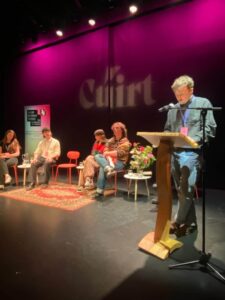
Young Writer Delegate Eddie Critchley performing at the showcase.
Eddie Critchley
I have always been fascinated by the voice of the author within the texts I read. I have read the same exact themes and situations in different novels but it is the voice of the writer and their characters that ensures that reading is refreshing each time. It is what makes a writer unique.
So, I made my way with some of my fellow delegates, Liam and Luke, to the Mick Lally Theatre, where Catherine Hearn, editor at Tolka, was in conversation about The Writer’s Voice with John Patrick McHugh, Maija Makela and Declan Toohey.
John Patrick McHugh read from his contribution to Issue Ten of Tolka, titled ‘Voice, Voice, Voice’. He explored the voice in his head as a youngster, playing with toy wrestlers, the voices of other writers he encountered in college that helped to shape the voice he himself writes in and, despite the sometimes gruelling process of workshops and the dissection of his work, the voice that gave him an unexplainable confidence when he sat down to the act of writing.
Maija Makela read an excerpt from ‘Ghost-bait’, where she begins to suspect that paranormal entities are present in an old coastal building where she spent some time as an artist in residence. A writer and singer/songwriter, Maija spoke about the similarities and differences in voice she found between writing and singing, and the sometimes-misunderstood voice of her favourite musician, Lana Del Rey.
House sitting during the funeral of a neighbour for an afternoon, Declan Toohey wrote about his wandering imagination and increasing anxiety as the hours passed. The writer’s voice in his head imagined intruders to the house, and the various reactions they and he would have upon his confrontation of them. When the dead arise in his mind, the ghost of his neighbour checks him, saying “In reality you were too busy making the world in your own image”. This quote, I feel, is the magic within the voice of all writers, the singular but unending imagining and questionings of the world.
To act as a conclusion to the event, Catherine played a game with both those on stage and the audience where we all had to guess whose voice the excerpts she read from belonged to. From what I remember now, after a bad start from us all, JP recognised the way John McGahern described an archway formed by overlapping trees on a path, and Declan could see Flann O’Brien in the line ‘It is nearly an insoluble pancake’. The game was a fun testament that the voice of an author is what separates each writer from the next.
You can click here to read our final two Young Writer Delegates’ reflections.