29 July, 2026
Literary Journal Spotlight #5: Swerve
Below, the editors of Swerve tell us a little about the magazine, and you can read an extract!
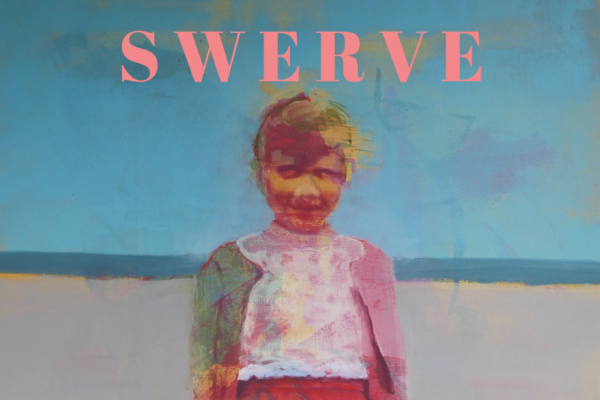
Swerve is a biannual journal—Summer and Winter—based in Skibbereen, West Cork. It is supported by Arts Grant funding from Arts Council Ireland and it is thanks to the generous grant we receive that we can pay all our artists and writers. Swerve publishes, poetry, prose and visual art and we arrange an annual artist/writer collaboration for inclusion in the journal. Our focus is on fresh new writing and visual art from Ireland and beyond with an open submission each year in March. We also commission and publish articles from established writers and artists.
The journal is available in print and digital formats and each issue consists of 150 pages in full colour. Find it here. Print copies may be found at selected bookshops in Ireland and the London Review Bookshop in the UK.
Independent, artist-run initiatives are essential for cultural life: we like to think that Swerve is creating a vibrant creative ecosystem in a small town in rural Ireland that also has international reach.
Swerve is not just a journal:
The Lit Lounge is our in-house performance space for monthly in-person reading events. It is partly supported with funding from Cork County Arts.
The Lit Lounge Online is our Zoom performance space with monthly live reading events for our international writers and audience.
The Swerve Residency Programme hosts writers and visual artists for short residencies at our live-work space throughout the year.
Swerve: Project Space is a pop-up that encourages non-mainstream visual art and shows work that may not find a home in more commercial galleries. There is an outdoor space that is ideal for sculpture.
Swerve supports new and emerging local talent by awarding an annual residency and solo show to two graduates from Crawford College of Art and a writing residency to a University College Cork creative writing graduate. The Managing Editor& Visual Arts Editor is Mich Maroney. The Poetry Editor is Dan Fraser, and the Deputy Poetry Editor is Catherine Ronan.
Extract: An Interview with Sinead Morrissey by Dan Fraser
The title of your memoir Among Communists is, of course, also the title of one of your early poems. Did writing the book make you return to your earlier poetry? If so, did you discover anything new or change your perspective on it?
I don’t like my early poetry very much, inevitably, but writing the memoir meant I had to imaginatively re-inhabit the world and voice of my younger self. And I could see that whilst I had a facility for language, those very early productions had not yet found their subject or their shape. The poem Among Communists, even if it wasn’t very good, was at least a beginning—a starting point—because it was simpler, less adorned, and because it was true to my lived experience. So the memoir became my journey to that moment, from birth to 21, taking in the many electrifying encounters with language along the way that made me want to be a writer in the first place.
Conversely, I wondered whether the process of writing about your upbringing changed the way you related to your memories from that time?
I think it deepened them by placing them within a larger, worked-out structure. Once I realised (it took a while) that I would have to order experience according to scenes in order to make the narrative work, key moments in my life began to open out, as though a door had been opened in front of me. Which makes the writing true to life in one way, in that all those things happened when they happened, but falsifying in another, because of everything else I was forced to leave out.
I wanted to a question about Belfast. How did the experience of writing about the city in prose differ from its place in your poems?
Belfast in the 1980s is definitely a character in the book and could even be read as the main protagonist. I haven’t written about the city per se in poems, probably because it’s too big a subject, but have focused instead on aspects of its history—such as the launch of the Titanic (1911), or Lilian Bland building and flying her own aeroplane (1910). With a bigger expanse to occupy in the memoir, I could fill in so much more of Belfast and its more recent history in a very subjective, sensual way—what it looked and smelled like, the dimensions of its meeting spaces, the quality of its light, what its soundtrack was.
I was particularly struck by the early recollections of film in the book and I wondered whether you see a connection between cinema and your approach to poetry and the making of images?
I didn’t like films very much when I was little. They frightened me. This was partly to do with being brought to films that were too old for me from a young age—I saw Tommy, The Car and Picnic at Hanging Rock when I was seven years old. But it was also to do with the intrinsic weirdness of film, even popular films like The Wizard of Oz, which I found deeply unsettling. Watching a film felt like being kidnapped. By contrast, I discovered independent reading when I was six. I remember consuming Enid Blyton’s The Rockingdown Mystery from start to finish in December 1977—and feeling instantly at home with a book. There was something gentler and more transactional about reading; because I got to build the world being described in my head, it wasn’t as disempowering. I’ve always associated poems more with photographs than films, in that both the photograph and the poem are stalled little snapshots of experience, preserved and rendered portable by form.
One of the most fascinating aspects of the book is the way communism places you in an oblique relationship to that extremely turbulent period of Irish religious and colonial history. The word, and collection of yours, which it brought to mind was Parallax. Would you say that term resonates with the place of communism in your early life? Further, how important has that sense of displaced perspective remained to your writing more generally?
Absolutely! Some of the most valuable things my childhood gifted me were about blindness and perspective—about the affordances of particular world views, as well as their drawbacks and limitations. I learned to codeswitch between the reality of my family, bound up with the Party and the Cold War, and other, divergent realities, bound up with the Troubles, lived out on the news and in school playgrounds all around me, which I couldn’t relate to. The Communist Party in Belfast was brilliantly correct on many issues, not least because it offered a non-sectarian space on the Left (there was no Labour Party). But there were other things it simply couldn’t see or acknowledge, such as Soviet-Bloc atrocities, because they were too damaging to the core narrative. Exploring displaced perspectives has been a key aspect of my writing ever since.
Following on from this, I wanted to ask about the place of the political in your work. You have poems which engage directly with political events and those in which politics seems to be an implicit force animating the language. Do you see poetry as inherently political?
Yes, poetry is inherently political, but only because almost everything is inherently political. It’s also so much more than a speech or a protest could ever be, because it is text which exists simultaneously in three dimensions instead of just two, deepened and complicated by form and the inherent unpredictability of poetic voice and address. The purpose of politics is to solve things. I don’t think a poem should solve anything. If it solves something, if it ties up its contradictions neatly at the end without a single paradox or irony left over, it’s probably a bad poem.
You’ve spoken previously about the relationship between inspiration and form, with the latter being a kind of compensatory force for the unpredictable nature of the former. Does that still hold true with what you are writing now?
I have a recurring dream in which I’m trying to get into the sea to swim but can’t—either the tide retreats in a blink or I’m standing in the sea and it suddenly drains away… I’m sure the sea is language, not language as a thing, but as an element—the way you describe politics in the previous question. But then there are other, briefer periods when the tide comes back. I wrote a new poetry collection last spring. I started in February and had finished by June. It took 16 weeks. I had only written 9 poems between 2016 and 2025 —hardly any poetry at all—so when I finally sat down to do it, the poems arrived in a blind rush. I suppose that sense of being connected to language is what I would call inspiration now.
Finally, I wanted to ask you about influences. Many of your poems refer to other poets or to reading poetry including, of course, the wonderful ‘Reading the Greats’. Do you, similarly to form, find influence, the relationship to previous generations of poets, an anchor for inspiration?
Yes of course. I can’t write poetry without reading it. Whatever spurs a poem into existence – a word, an idea, a postcard, a title—it is also spurred into existence by poetry. I don’t read very widely because I can’t cope with reading widely. After a while, reading widely simply isn’t helpful. But brilliant work—of which, mercifully, there is no shortage—is always there to teach me how to be better than I was before I read it.